
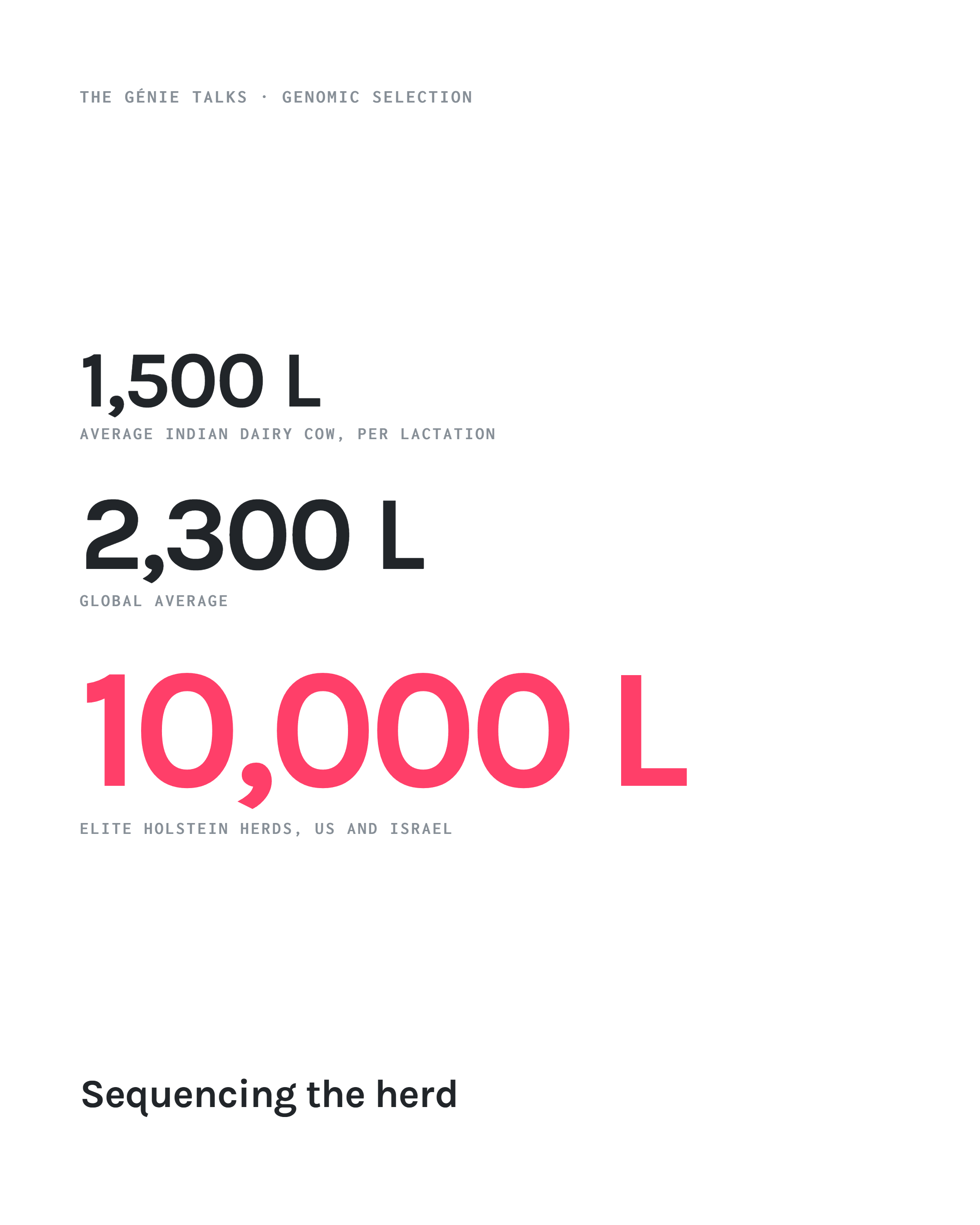
For decades, closing that gap has meant progeny testing: waiting for a bull's daughters to mature and lactate before confirming whether their sire was worth breeding. The cycle takes five to seven years. Capital is tied up in animals that may prove genetically mediocre. Genetic progress accumulates slowly, one generation at a time. It is a rational system built for an era without better options.
Next-Generation Sequencing (NGS) offers a better option. The question worth examining is not whether the technology works (in controlled settings, it demonstrably does) but whether the Indian dairy sector, with its specific structural realities, can actually absorb it at scale.
The core proposition: compress the generation interval
Genomic Selection (GS) replaces the wait-and-see logic of progeny testing with a predict-early logic. By sequencing the genome of a calf shortly after birth, or at the embryonic stage, breeders can generate an Estimated Breeding Value (EBV) with statistically meaningful accuracy, without waiting for phenotypic expression across a generation.
The mechanism relies on Single Nucleotide Polymorphism (SNP) arrays or, increasingly, low-pass Whole Genome Sequencing combined with imputation algorithms. Both approaches identify genomic markers statistically associated with traits of commercial interest: milk volume, fat and protein content, somatic cell count, fertility. The EBV produced is not a guarantee (it is a probability-weighted prediction) but it is accurate enough to rank animals at birth with confidence, allowing breeders to cull the bottom of the distribution early and concentrate investment on high-potential genetics.
The business arithmetic is straightforward: a shorter generation interval means faster genetic gain per unit of time. For a national herd of India's scale, even a modest improvement in the rate of genetic gain compounds into substantial output gains over ten to fifteen years. The organisations that supply sequencing services, reference data, and predictive analytics will capture a portion of that value. The infrastructure opportunity is real.
What is less straightforward is how you get there from here.
The Indian context: where the standard playbook breaks down
Most of the genomic selection literature, and most of the commercial infrastructure supporting it, was built for European and North American Bos taurus breeds, particularly Holstein Friesian. India's genetic landscape is fundamentally different, and the differences are not cosmetic.
The reference genome problem
Genomic prediction depends on training datasets: large reference populations where animals have both genotype and detailed phenotype data, used to calibrate the statistical models that convert raw SNP profiles into EBVs. For Holstein cattle globally, these reference populations number in the hundreds of thousands of animals. For Indian indigenous breeds (Gir, Sahiwal, Tharparkar, Red Sindhi) the reference populations are thin, geographically fragmented, and often phenotypically inconsistent in how they were recorded.
This is not a secondary concern. Applying Holstein-trained genomic models to Bos indicus populations produces degraded prediction accuracy, sometimes severely so. The commercial viability of NGS in India therefore hinges on building deep, high-quality reference genomes and training datasets specifically for indigenous breeds. This requires coordinated investment, from government bodies like NDDB and ICAR, from state government breed improvement programmes, and from private sequencing companies, over a sustained period. It is infrastructure work before it is product work, and it is currently underfunded relative to its importance.
The ownership structure problem
Roughly 70% of India's dairy animals are held by smallholder farmers with two to five animals each. Genomic selection as it is conventionally practised assumes some form of organised breeding programme (a cooperative, a stud farm, a vertically integrated dairy) that can collect samples, process data, and act on the resulting EBVs. The atomised smallholder structure does not map cleanly onto this model.
The most credible path to scale runs through cooperatives and aggregators. The Amul model, with federated village societies feeding into district unions, already has the logistics infrastructure to collect milk samples. Semen and tissue sample collection for genotyping could, in principle, be layered onto this network. Private dairy integrators operating in states like Punjab, Haryana, and Maharashtra represent a more concentrated entry point, with larger individual herd sizes and existing incentive structures for genetic improvement.
Neither channel is currently operating at the scale required to generate reference populations large enough to train high-accuracy models. The sequencing technology is available; the data aggregation infrastructure is not.
Climate stress and the case for indigenous genetics
This is where the Indian context creates a genuine competitive advantage, not just a complication. Bos indicus breeds evolved under conditions of heat, humidity, tick pressure, and feed scarcity that Bos taurus breeds handle poorly. As climate volatility increases, and India's dairy-producing states are among the most exposed to heat stress in the world, this adaptation has direct commercial value. Heat stress reduces milk yield, impairs fertility, and increases disease susceptibility. Herds that cannot thermoregulate efficiently under 35°C ambient temperatures will underperform regardless of their genetic potential for milk production.
The traits underlying heat tolerance (thermoregulation, tick resistance, metabolic efficiency under nutritional stress) are complex and polygenic. Traditional crossbreeding programmes attempt to introgress Bos indicus hardiness into high-yielding crossbreeds, but without molecular markers to track which genomic regions carry the relevant alleles, breeders are working partially blind. The process is slow and often results in losing yield while gaining hardiness, or vice versa. NGS enables marker-assisted introgression at a level of precision that makes it possible to select simultaneously for productivity and resilience, rather than trading one off against the other.
This is probably the strongest near-term commercial case for NGS in Indian dairy, and it is underemphasised in most industry discussions that focus primarily on yield uplift.
Disease resistance: real stakes, long timelines
Mastitis, Foot-and-Mouth Disease, and Brucellosis impose measurable annual losses on Indian dairy: conservative estimates for mastitis alone run to several thousand crore rupees in lost yield and treatment costs. Genetic markers associated with immune function and disease resistance have been identified in cattle populations globally, and selecting for these markers can, over generations, reduce herd susceptibility.
The qualifier “over generations” matters. Disease resistance traits have lower heritability than production traits, meaning genomic predictions for them are less accurate and the genetic gains per generation are smaller. NGS can accelerate the process, but it cannot shortcut it. A commercial dairy making investment decisions on a three-to-five year horizon should understand that genomic selection for disease resistance is a long-cycle bet, not a near-term cost reduction lever. The value is real; the timeline is not short.
A2 milk: durable opportunity or premium bubble?
The A2 milk market in India has grown rapidly, driven by health claims around the A2 beta-casein protein variant and a consumer segment willing to pay a meaningful premium, often 40 to 80 rupees per litre above commodity prices. Many indigenous breeds, including Gir and Sahiwal, are predominantly A2, which has made the A2 narrative partly a vehicle for promoting indigenous breed products.
NGS enables efficient, population-scale testing for the A1/A2 beta-casein genotype, removing the need for individual animal testing and allowing herds to be certified at lower cost. Simultaneously, broad-spectrum sequencing allows selection for correlated component traits (fat percentage, protein content) that also command premiums in the formal market.
The investment case here has one important caveat: the A2 premium is, at present, partially a marketing premium rather than a purely science-backed one. The clinical evidence on A2 milk's health advantages over A1 is suggestive but not conclusive. If consumer scrutiny increases or regulatory bodies require stronger evidentiary standards for health claims, the premium could compress. Dairies building their genomic selection strategy heavily around A2 should treat the premium as a current opportunity to be harvested rather than a permanent structural feature of the market.
The bioinformatics layer: where bottlenecks concentrate
Sequencing generates data. Turning data into actionable breeding decisions requires bioinformatics pipelines capable of processing whole-genome reads, imputing missing variants, running genomic BLUP models, and outputting EBVs in a format that cooperatives and farm managers can act on. At volume, this is not a trivial computing problem.
The cost of sequencing itself has fallen dramatically and will continue to fall. Low-pass WGS, sequencing at 1–2x coverage rather than the 30x standard for human clinical genomics, combined with statistical imputation can achieve SNP array-comparable accuracy at sequencing costs that are approaching commercial viability for Indian dairy, likely in the range of $15–30 per animal at current rates, trending lower. The bioinformatics and analytics layer is a less commoditised, more defensible part of the value chain.
The companies and institutions that build proprietary imputation reference panels calibrated to Indian cattle populations, and that develop prediction models trained on locally generated phenotype data, will hold a durable advantage. This is a data network effect: the more Indian cattle are sequenced and phenotyped within a given platform, the more accurate its predictions become, which attracts more customers, which generates more data. The window to build that position is open now, while the field is not yet crowded.
What needs to happen, and who needs to do it
The NGS opportunity in Indian dairy is genuine but it will not self-assemble. Several things need to happen in roughly the right sequence.
First, reference population development for indigenous breeds needs to be treated as shared infrastructure, not proprietary advantage. NDDB and ICAR have the mandate and partially the resources; they need private sequencing partners willing to co-invest in a dataset that ultimately benefits the whole sector. Some form of public-private consortium, with clear data-sharing agreements and governance, is probably the right structure.
Second, the cooperative channel needs to be activated as a sample aggregation network. The logistics already exist. What is missing is a sequencing service provider, or a NDDB-backed programme, that can standardise sample collection protocols, offer subsidised genotyping to member farmers, and return EBVs in a usable form to the cooperative's breeding programme.
Third, bioinformatics capacity inside India needs to scale. Currently, most genomic data from Indian cattle research flows to academic analysis pipelines that are not designed for commercial turnaround times. Commercial-grade cloud bioinformatics, fast, auditable and integrated with farm management systems, is largely absent from the Indian market.
None of these are technically unsolved problems. They are coordination and investment problems, which in some ways are harder.
The honest assessment
Next-Generation Sequencing will matter for Indian dairy. The direction is not in serious doubt. The productivity gap is real, the technological capability exists, and the economic case for closing that gap is compelling enough to attract sustained investment.
What deserves scepticism is the timeline and the linearity of the story. The standard pitch (sequence the herd, generate EBVs, watch yields rise) skips over the reference genome deficit, the smallholder aggregation problem, the bioinformatics infrastructure gap, and the long build time for disease resistance traits. These are not footnotes. They are the actual work.
The organisations that treat them as such, that invest in the unglamorous infrastructure before expecting product returns, will be positioned to capture value when the market matures. The organisations that try to skip to the product before the infrastructure is ready will find that the technology works and the business doesn't.