
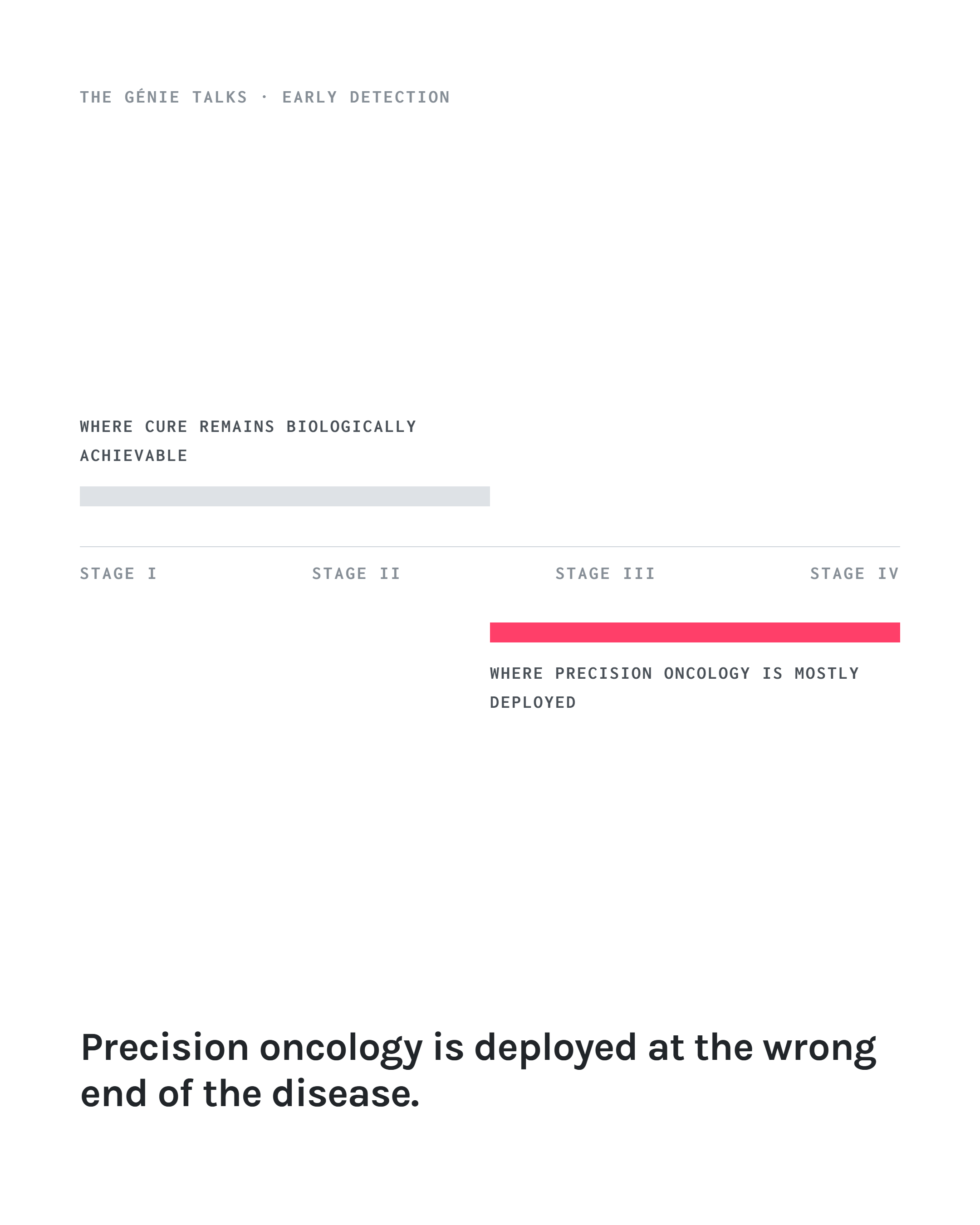
The argument of this piece is that precision oncology must migrate upstream: to germline risk stratification, early molecular detection, and targeted intervention at stages when cure remains biologically achievable. The case is strong. But its strongest form requires confronting, not glossing, the obstacles that have so far prevented that migration.
Why late-stage intervention has a biological ceiling
By Stage III or IV, a tumour has undergone extensive clonal evolution. It is no longer a uniform entity but a heterogeneous population of cells carrying divergent mutations. A targeted therapy may eliminate the dominant clone; resistant subpopulations survive and expand. The tumour burden also overwhelms the therapeutic index of available drugs. These are not failures of pharmaceutical ingenuity; they are biological constraints that no incremental refinement of late-stage treatment will resolve. The ceiling is structural.
Risk interception: before the tumour exists
The earliest point of intervention occurs before malignancy manifests. Germline testing, the analysis of inherited DNA for mutations such as BRCA1/2, APC, or Lynch syndrome, identifies patients with elevated lifetime risk and enables genuine prevention: rigorous surveillance, prophylactic surgery, or chemoprevention. This is not precision treatment; it is precision interception, and it represents the most upstream application of molecular knowledge in clinical oncology.
The breast cancer paradigm, and why it is a partial model
Breast cancer is the canonical example of early-stage precision care working as intended. Five-year survival for localised disease now exceeds 99%. Early mammographic screening was followed by molecular subtyping at biopsy, and targeted therapies (Trastuzumab for HER2-positive disease, CDK4/6 inhibitors for hormone receptor-positive disease) are now integrated into treatment at diagnosis rather than reserved for metastatic relapse.
The breast cancer model is instructive, but it should not be treated as a template that transfers cleanly to all solid tumours. Breast cancer succeeded partly because of anatomical accessibility: it lends itself to physical examination and mammography in ways that pancreatic or ovarian cancer do not. In deep-tissue cancers, the tools enabling early breast cancer intervention have no direct equivalent. The inference from breast cancer to pancreatic cancer requires a technological leap, not merely a policy shift, and the argument is weakened when that distinction is elided.
The role of chemotherapy in an integrated model
In an early-intervention model, chemotherapy's role is refined rather than reduced. Neoadjuvant regimens administered before surgery can shrink localised tumours sufficiently to permit minimally invasive excision. Adjuvant regimens, delivered after local therapy, target residual microscopic disease. What changes is not the existence of chemotherapy but its deployment: genomic assays (OncotypeDX, MammaPrint, and their successors) now allow clinicians to identify which patients actually benefit from cytotoxic treatment and which can be spared its toxicity without compromising outcomes.
Liquid biopsy and next-generation detection: promise and current limits
For deep-tissue cancers (pancreatic, ovarian, lung) early detection requires tools capable of identifying a tumour before it produces symptoms or appears on standard imaging. Circulating tumour DNA (ctDNA) analysis, the technology underlying multi-cancer early detection (MCED) tests, does this by identifying molecular signatures shed by tumours into the bloodstream.
Investigational liquid biopsy platforms show meaningful signal at early stages in selected cancer types, with sensitivity that varies considerably by tumour origin and stage. Tests such as Galleri have demonstrated proof of concept, but sensitivity for Stage I disease across cancer types remains limited, approximately 16 to 18 percent in published analyses, which is precisely the stage where early detection matters most. These tests are not yet fully validated in the regulatory or clinical sense, and describing them as such obscures an important gap between current capability and clinical deployment at scale.
When a ctDNA signal is detected, the diagnostic chain requires a second step: functional imaging to localise the source. Following surgical excision, comprehensive next-generation sequencing of the resected tumour provides a genomic map that can guide adjuvant therapy selection. The sequence (blood-based detection, imaging localisation, surgical excision, genomic profiling, precision adjuvant care) is conceptually coherent. The bottleneck is the first step.
The infrastructure problem
The integrated model described above (population-level germline screening, ctDNA-based early detection, imaging confirmation, surgery, genomic profiling, and targeted adjuvant therapy) is not principally constrained by scientific knowledge. The sequencing technologies exist. The targeted agents exist. The constraint is systemic: who pays for population-level liquid biopsy screening, how are positive signals followed up in health systems already operating at capacity, and what happens when an MCED test detects a signal that imaging cannot localise? Until these questions have answers, the clinical vision outpaces the infrastructure required to realise it.
The translation problem
The biological case for moving precision oncology upstream is not in serious dispute: tumours are most tractable when localised, least heterogeneous, and carrying the lightest mutational burden. The scientific tools to intervene at that stage (germline testing, ctDNA assays, NGS profiling, targeted agents) are real, increasingly refined, and in specific cancer types and risk populations, already demonstrating survival benefit.
What the field has not yet resolved is the translation problem: how a coordinated, multidisciplinary early-intervention model gets embedded into health systems structurally oriented toward treating established disease. That translation requires not only validated detection technologies but reimbursement frameworks, clinical decision pathways for ambiguous signals, and the workforce capacity to manage an expansion in diagnosed early-stage disease. The scientific case for earlier precision oncology is strong enough not to require inflation. The harder and more important work is making it operational.